
Preparing Your Home’s Construction for Winter in Los Angeles
Winter construction prep in Los Angeles comes down to one thing: keeping water out of your open structure. Most homeowners think a mild LA winter means no risk, but the city receives about 15 inches of rain annually, and roughly 80% of it lands between November and March. An exposed roof deck or open framing during one solid storm system can push a project back weeks and leave you holding a mold remediation bill your insurance might not cover. If you’d rather not deal with the prep yourself, Sawyer Remodeling puts a written weatherproofing plan in your hands before any work starts – call (254) 276-4058.
Key Takeaways
- 80% of LA’s annual rainfall arrives between November and March, often in short but intense El Niño-driven storm bursts.
- The most vulnerable construction phases are open framing, mid-roofing, and fresh concrete – each needs a different temporary weatherproofing approach.
- Hillside homes face compounding risk from saturated soil, retaining wall stress, and drainage failures during active construction.
- A standard homeowner’s policy typically excludes weather damage to an open construction site – builder’s risk coverage fills that gap.
- LADBS inspection backlogs after storm events routinely add 1 – 3 weeks to permit timelines, so build buffer weeks into your schedule.
Which Construction Phases Are Most Vulnerable to LA Winter Rain
Not every stage of a remodel carries the same winter risk. We’ve walked onto enough Los Angeles job sites in January to know exactly which phases keep a contractor up at night.
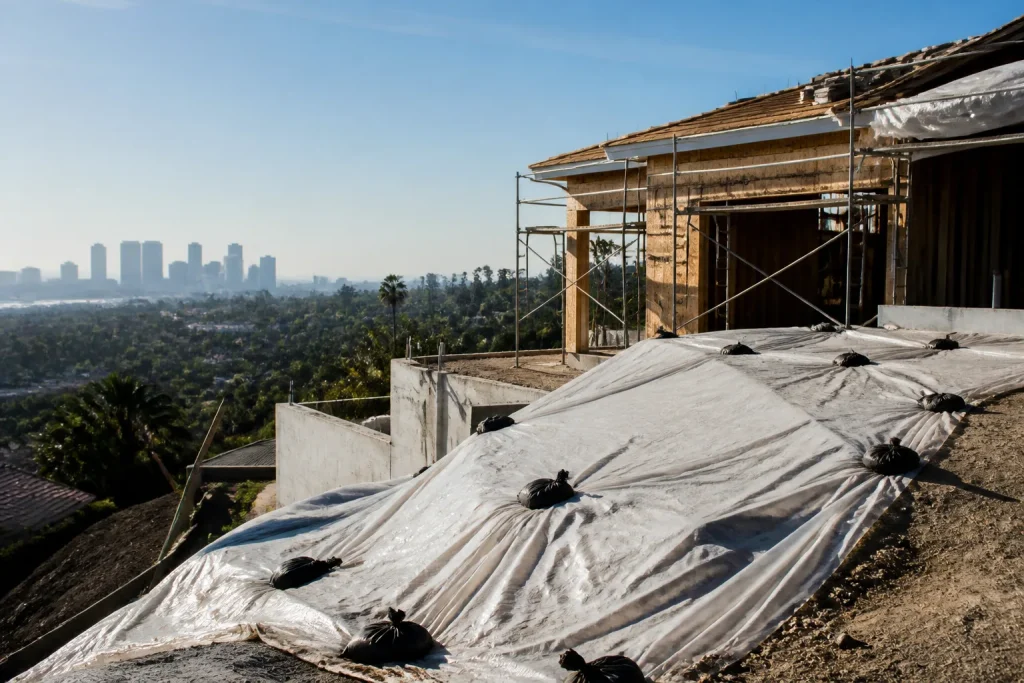
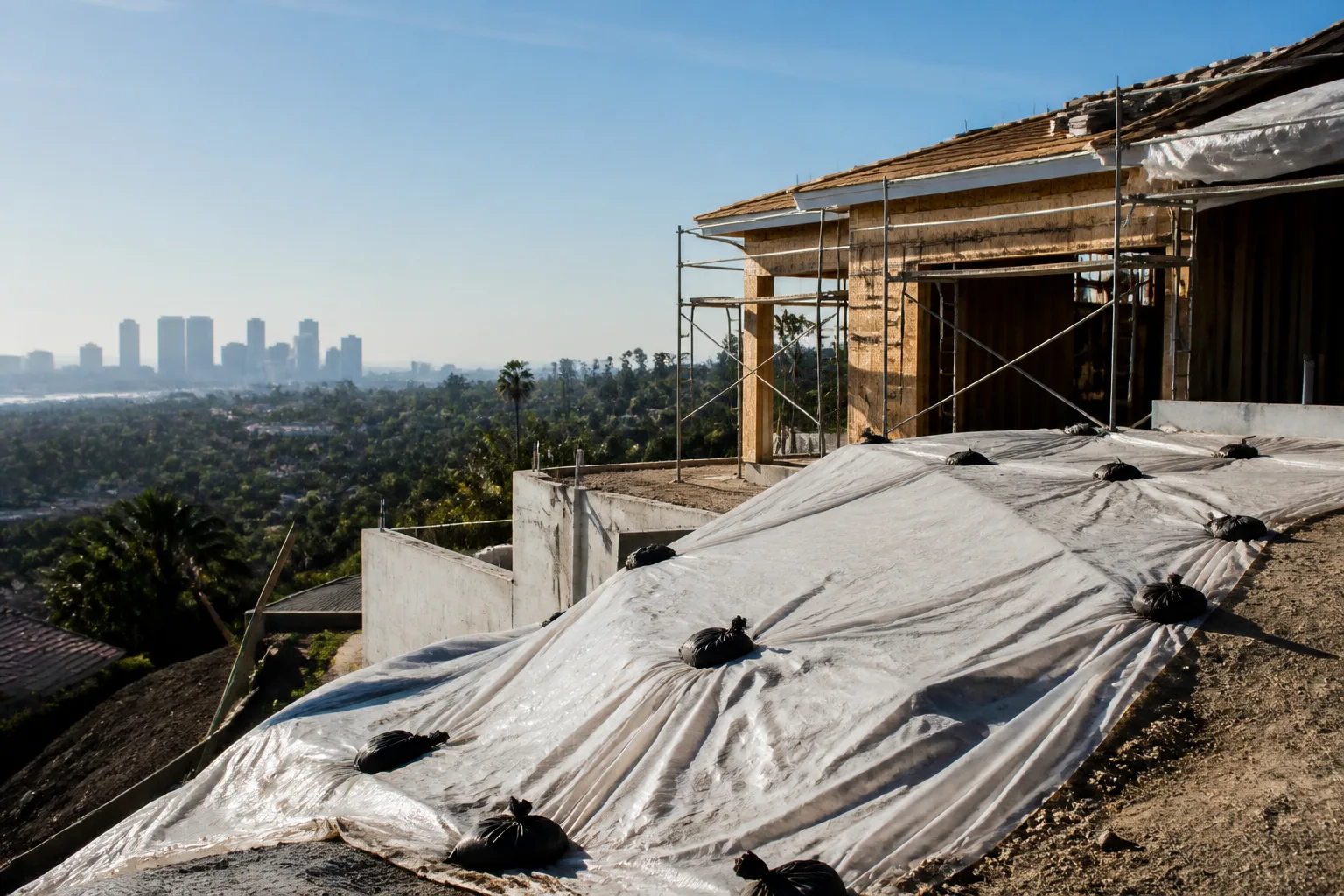
Open framing is the most exposed moment in any project. Once walls are up but before the roof sheathing, a single overnight storm can soak every stud, floor joist, and energy-inefficient cavity you’ll later fill with insulation. Wet lumber cups, twists, and grows mold within 48 hours. We specify tarping protocols that include ridge-to-eave coverage, weighted edges, and drainage diverter strips along the building perimeter. This is standard on every home renovation in Los Angeles we run through the winter months.
Mid-roofing is riskier than people think. A roof tear-off in December is a race against the forecast. Between old roofing removal and new underlayment, your home is essentially a bucket with a felt lid. We schedule roof work in winter only when we can commit to continuous coverage – meaning a crew that shows up every day until the roof is weather-tight. No gaps, no weekends of open decking. If your project sits mid-roof during a storm, tarping is a stopgap, not a solution.
Fresh concrete flatwork is the stage everyone forgets. Driveways, walkways, and patio pads poured between November and March in LA cure slower in cool, damp conditions. Rain arriving within 24 hours of a pour can wash cement paste off the surface, leaving exposed aggregate and a weakened finish. We check 72-hour forecasts before scheduling any flatwork and keep curing blankets on hand when nighttime temperatures drop below 50°F. The difference between a properly cured concrete slab and a rain-damaged one is visible for the life of the home.
Why Hillside Homes Face Compounding Winter Risk During Construction

Los Angeles hillside properties are a different animal entirely. Flat-lot homes deal with rain as it falls. Hillside homes deal with rain as it travels – down slopes, into cuts, against retaining walls, and through drainage systems that active construction has often disrupted.
When framing a hillside remodel, the excavation and grading work shifts the way water moves across your property. A slope that once shed water naturally into a swale might now channel it toward your foundation cut. We use silt fencing and temporary berms to redirect sheet flow away from open excavations. On a project over in Mount Washington a few winters back, we watched a neighbor’s unprotected excavation fill with nearly a foot of water after one heavy storm – the resulting mud cleanup and recompaction delayed their foundation work by three weeks. The fix costs a fraction of that if the diversion is in place before the rain hits.
Retaining walls are another winter pressure point. Soil gets heavy when saturated, and that added weight shifts loads against retaining walls that may already be stressed by nearby excavation. If your project includes any work near a retaining structure, insist on a pre-winter drainage assessment. A French drain or additional weep holes can mean the difference between a wall that handles the season and one that slowly leans into your foundation. We’ve seen this play out in Los Feliz and Silver Lake enough times to make drainage review part of our standard winter site plan on any hillside project.
What a Legitimate Contractor’s Winter-Ready Site Plan Includes
If your contractor can’t show you a written winter site plan, that’s a red flag. A real winter-ready plan has three parts, and every one of them should be specific to your property and your project phase.
1. Tarping protocols. What gets tarped, what type of tarp, how it’s secured, and who checks it after each storm. Loose tarps flapping in wind do more damage than no tarp at all – we anchor with furring strips and check all tiedowns within 24 hours of any rain event. This is the kind of thing we document in photo updates under The Relay Visibility Guarantee, so you can see the coverage without driving to the site.
2. Drainage diversion. Where does water go when it hits your property? The plan should mark the temporary flow paths, the location of any silt fence or waddle, and the outlet point. On flat lots in the Valley, this might mean pumping from the low corner. On a hillside in Echo Park, it means a swale and check dam system that slows water before it reaches the excavation.
3. Material storage standards. Framing lumber stacked directly on dirt soaks up groundwater even on dry days. We store lumber on raised racks or cribbing, cover it with breathable material that prevents condensation, and keep drywall and insulation fully inside a sealed space. Wet-driven drywall is a mold liability you don’t want stacked in your living room.
If your site plan includes none of these three elements, ask for them in writing. A contractor who ignores winter prep in Los Angeles is quietly betting on a dry season. You’re the one who pays if the bet misses.
What happens when you call
- 1
A real person answersNo phone trees - you reach a local pro.
- 2
You get an upfront price rangeHonest numbers before anyone is dispatched.
- 3
A background-checked tech heads outLicensed & insured, dispatched right away.
- 4
You approve before work beginsNothing starts until you say go.
Insurance Gaps During Active Construction: What Your Policy Won’t Cover
This is the most uncomfortable conversation we have with homeowners, and it’s one most people don’t think about until after a storm. Your standard homeowner’s insurance policy typically excludes weather damage to a structure that’s actively under construction. Open roofs, missing walls, exposed framing – the policy language treats these as “known hazards,” and the carrier has no obligation to pay for rain intrusion or mold remediation that occurs because the home wasn’t sealed.
What fills the gap is builder’s risk coverage, sometimes called course of construction insurance. It covers the structure while work is underway, including weather damage to materials and partially completed work. If your project involves structural changes or roof work that extends into the rainy months, this is not optional. In our experience across Los Angeles, a builder’s risk policy adds roughly 1 – 3% of the project cost. That’s a small line item compared to the cost of tearing out rain-soaked insulation and remediating mold behind newly hung drywall.
Ask your contractor who carries builder’s risk – them or you. We’ve seen projects where neither party had it, and after one storm damaged an open floor system, the homeowner was left arguing with an insurer that pointed to the exclusion clause. Get the coverage sorted before the first rain, not after.
When to call a pro: If you’re in the middle of a renovation and your contractor hasn’t put a written weatherproofing plan in front of you, or if you’re unsure whether builder’s risk coverage is in place, call us. We’ll walk the site and tell you exactly what’s exposed and what it would take to protect it. Estimates are free. Call (254) 276-4058.
The Scheduling Reality: Winter Permits and LADBS Backlogs
One of the quieter costs of winter construction in Los Angeles is scheduling slippage you can’t control. When a major storm system moves through, LADBS inspection volume spikes. Inspectors get pulled to priority checks – hillside failures, structural concerns after mud events, emergency response calls – and routine inspections slip. We’ve seen a standard framing inspection that would take two days to schedule in October take seven to ten days in late January.
The practical effect is that any project that needs multiple inspections – which every permit-bearing remodel does – runs at the pace of the system, not the pace of the work. A framing inspection that slips a week cascades into delayed insulation, delayed drywall, delayed finishes. None of that is the contractor’s fault, but it’s the homeowner’s timeline that stretches.
The fix is to plan winter projects with buffer weeks built into the schedule. If a job would take 12 weeks starting in June, assume 14 to 15 weeks starting in December. A well-run site plan accounts for this from the outset and keeps you informed with the same live updates and photo verification we provide under The Relay Visibility Guarantee. The price is already in writing, so the time slippage doesn’t become a cost overrun – you know the number before the first inspection gets bumped.
The Bottom Line
Winter construction in Los Angeles is manageable, but it’s not automatic. The mild climate lulls people into thinking the season doesn’t matter, then a two-day storm system delivers half a foot of rain onto an open roof deck. The homes that come through cleanly are the ones with tarping protocols, drainage plans, builder’s risk coverage, and schedules that account for inspection slowdowns.
If you’re planning a remodel between November and March, or if you’re mid-project and unsure whether your site is winter-ready, call us. Sawyer Remodeling has been running construction sites through LA winters since 2005. We’ll give you a written site assessment and a free estimate. Call (254) 276-4058. If you’re ready to dig deeper, start with our Sawyer Remodeling home page or see our work as a general contractor in Los Angeles and bathroom remodeling in Los Angeles.
Frequently Asked Questions
Yes, because the threat isn’t cold – it’s water. Los Angeles gets most of its rainfall between November and March, and an exposed construction site absorbs that water quickly. Open framing, partially roofed structures, and fresh concrete are all vulnerable to rain damage regardless of temperature. Winterizing in LA means water management, not freeze protection.
Typically 1 – 3% of the total project cost for a standard remodel. A $100,000 renovation might run $1,000 to $3,000 for course of construction coverage, depending on the scope and the phase your home will be in during the rainy months. That’s a fraction of what mold remediation and structural drying cost out-of-pocket when a standard homeowner’s policy excludes the claim. Call (254) 276-4058 for guidance on what your specific project needs.
Some phases, yes. Interior work behind sealed walls, plumbing rough-ins, electrical, and HVAC can proceed through most rain events. Framing, roofing, concrete flatwork, and exterior siding generally need dry conditions, and we schedule those phases around 72-hour forecasts during winter months. A good plan sequences the work so interior crews stay productive when exterior crews are weathered out.
First, document the site with photos immediately after the storm. Then contact your contractor and verify the condition of all tarping, drainage channels, and material storage. Check the low points of the structure for standing water, and if you’re mid-roof or have open framing, get a professional on site within 48 hours to assess moisture levels and prevent mold growth. If you don’t have a contractor you trust, call (254) 276-4058 and we’ll walk the site with you.
Written by Luca Romano, Owner at Sawyer Remodeling, serving Los Angeles since 2005.
Need Construction Help?
Call Sawyer Remodeling - licensed & insured, here with fast after-hours help in Los Angeles.
(254) 276-4058